Intelligent Robotic System for Autonomous Fire Detection and Suppression
An autonomous ground robot combining YOLOv8 flame detection with LiDAR SLAM and A* path planning, navigating to and suppressing fires in cluttered indoor environments.
- Category
- Robotics Engineering & AI
- Stack
- YOLOv8, ROS2, SLAM, Embedded Systems
- Applications
- Industrial Safety, Smart Buildings
- Completed
- April 2025
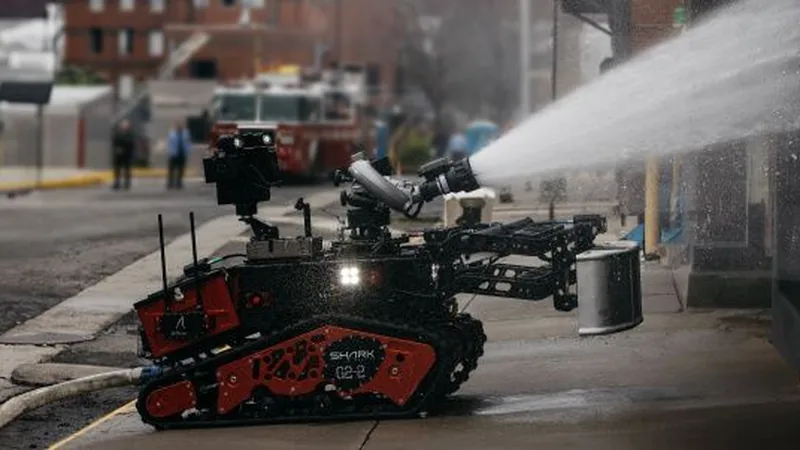
Fire safety is critical in both residential and industrial settings, with rapid response being essential for minimizing damage and saving lives. This project focused on developing an autonomous robot capable of detecting fire outbreaks, navigating to the location and deploying appropriate suppression methods without human intervention. The system is designed to operate in environments where human access might be limited or dangerous.
The fire fighting robot integrates multiple systems to achieve its autonomous capabilities:
- YOLOv8-based computer vision for flame and smoke detection
- Thermal imaging camera for detection through smoke/obstacles
- SLAM (Simultaneous Localization and Mapping) for environment understanding
- A* pathfinding algorithm with dynamic obstacle avoidance
- Custom-designed fire suppression system with multiple agents
- Real-time gas and temperature sensor array
- Differential drive locomotion with high-torque motors
- NVIDIA Jetson Nano for on-board processing
Perception and Detection Systems
Fire detection reliability is critical for the robot's effectiveness:
- Multi-modal fire detection combining RGB and thermal imaging
- Custom dataset of 15,000+ fire scenarios under varied conditions
- YOLOv8 model trained with data augmentation for robustness
- False positive reduction using temporal consistency checks
- Flame size and intensity estimation for appropriate response
- Smoke density analysis for navigation planning
Navigation and Pathfinding
The robot's ability to navigate safely in hazardous environments is engineered with:
- Real-time mapping using LiDAR and depth sensors
- Custom A* implementation with heat and risk heuristics
- Dynamic path replanning when obstacles are encountered
- Thermal-aware navigation to avoid dangerous areas
- Position tracking using sensor fusion (IMU, encoders, visual odometry)
- Fail-safe retreat mechanisms for critical situations
A critical aspect of the robot's functionality is its fire suppression system. The robot utilizes a multi-agent approach with different suppression methods based on fire type and size:
- CO₂-based suppression for electrical fires
- Water mist system for Class A fires (ordinary combustibles)
- Dry chemical system for Class B fires (flammable liquids)
- Fire type classification using spectral analysis
- Suppressant level monitoring and optimization
System integration presented significant challenges, particularly in coordinating the various subsystems under emergency conditions. The robot uses a hierarchical control architecture with a high-level decision-making layer that coordinates between perception, navigation and suppression subsystems. ROS2 (Robot Operating System) provides the middleware for inter-process communication, enabling modular development and testing of individual components.
Power management was another significant challenge, as emergency operations require high power draw from motors, pumps and computing systems. A custom power distribution system was developed with priority allocation, ensuring critical systems remain operational even under low battery conditions. The robot incorporates a hybrid power system with high-capacity LiFePO₄ batteries for regular operation and supercapacitors for handling peak power demands during suppression activities.
Testing and validation used controlled fire scenarios staged across several indoor environments. The robot demonstrated a 90% success rate in autonomously detecting, navigating to and suppressing fires, with an average response time of 45 seconds from detection to suppression initiation. Failure cases were primarily in extremely cluttered environments where navigation became challenging, leading to the development of improved obstacle avoidance algorithms.